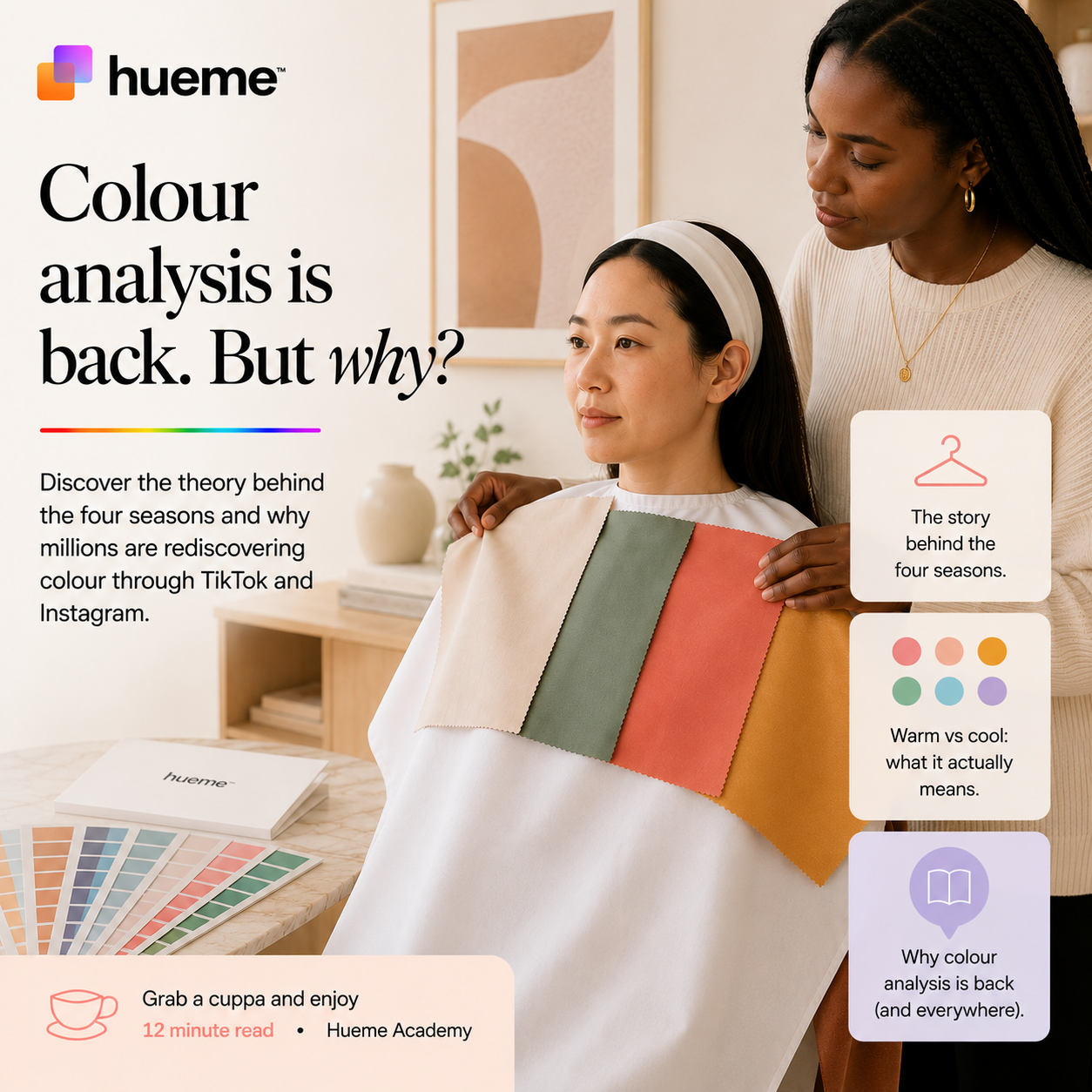
You've probably seen it on TikTok. A woman sits down, coloured drapes start going on, coming off, and somewhere in the middle of it all she finds her colours. High dopamine, genuinely satisfying to watch. But what's actually going on, and is there proper science behind it?
So what's all the fuss about?
Whether you've had a proper colour analysis done, watched one online, or simply heard the word "season" used in a way that had nothing to do with the weather, you'll know this topic is having a moment. The #coloranalysis hashtag has close to a billion views on TikTok. Reels of women being draped in fabric swatches get millions of views. It's become one of those things people find genuinely compulsive to watch, even if they're not quite sure why.
But colour analysis isn't new. Not even close. It's actually been around in one form or another for over a hundred years, which makes the current TikTok moment feel less like a trend and more like a very overdue comeback.
The roots go back to the 1920s, to a Swiss artist named Johannes Itten who was teaching at the Bauhaus school in Germany. Itten noticed something interesting about his students: when they were left to choose their own colour palettes, they consistently picked colours that reflected their own natural colouring. Warm-toned students reached for warm colours. Cool-toned students reached for cool ones. From that observation, he started developing the idea that people could be grouped into colour types, and he was the first to name those types after the seasons. Spring, Summer, Autumn, Winter. Even back then.
Itten's students reached for colours that matched their own skin. He noticed. The rest, eventually, followed.
His ideas sat mostly in art theory circles until the 1980s, when colour absolutely exploded into mainstream culture. It was a very eighties explosion. Power dressing was in. Image consultancy was on the rise. Women were being advised on how to dress for the boardroom, how to project authority, how to present. Colour was a huge part of that conversation. And in 1980, an American consultant named Carole Jackson published Color Me Beautiful, a book that took Itten's seasonal framework and put it in the hands of ordinary women everywhere. It became a phenomenon. Department stores ran colour consultations. Women kept fabric swatches in their handbags to hold against clothes in shops. Being told your season felt like being let in on a secret.
Then the nineties arrived, and with them a very different mood. Individualism was everything. The idea of being sorted into a category, told these colours are yours and those ones aren't, started to feel a bit restrictive. A bit corporate. A bit un-fun. Fashion went deliberately rule-free, and colour analysis quietly retreated. It never went away entirely, but it stopped being talked about.
The nineties decided it didn't want to be put in a box. Fair enough. But the boxes were still there.
And now here we are. Like a lot of things that went quiet in that era, it's back, and it's back bigger. The TikTok versions are faster and more visual than anything a 1980s image consultant could have imagined, but the underlying idea is exactly the same. Your natural colouring, the combination of undertones in your skin, hair and eyes, responds better to some colours than others. Finding out which ones is, it turns out, very satisfying to watch and even more useful to know.
Some of you will know all of this already. Some of it might be completely new. Either way, we're going to take you through the actual science behind it: what warm and cool really mean, how the four seasons work, and why the system has expanded to twelve sub-seasons. It can sound a bit school-ish when you list it out like that, so we'll try to keep it feeling less like a lesson and more like a conversation. That's what it should be.
Where it starts: warm, cool, and why it matters
When people first hear about colour analysis, they often assume it's about hair colour. Or eye colour. Or whether you're blonde, brunette or silver. It isn't. Those details matter, but they're not the starting point.
The starting point is temperature. Specifically, the undertone sitting beneath your skin. Not the surface colour, but the warmth or coolness underneath it.
This is where a lot of people get confused, because undertone isn't always what you'd expect. A fair-skinned redhead can be warm. A woman with deep skin can be warm. A pale blonde can be cool. A woman with deep brown skin can be cool. There's no predictable shortcut based on appearance alone. Temperature runs underneath the surface, which is exactly why it requires a proper look.
Warm seasons
Spring & Autumn
Cool seasons
Summer & Winter
Once you understand temperature, you can begin to narrow down which of the four seasonal families your colouring most naturally belongs to.
Meet the four seasons
Each season is a collection of colours that share the same essential character. They've been grouped together because they share undertone, depth and clarity in a way that tends to work harmoniously with the colouring of the people in that group.
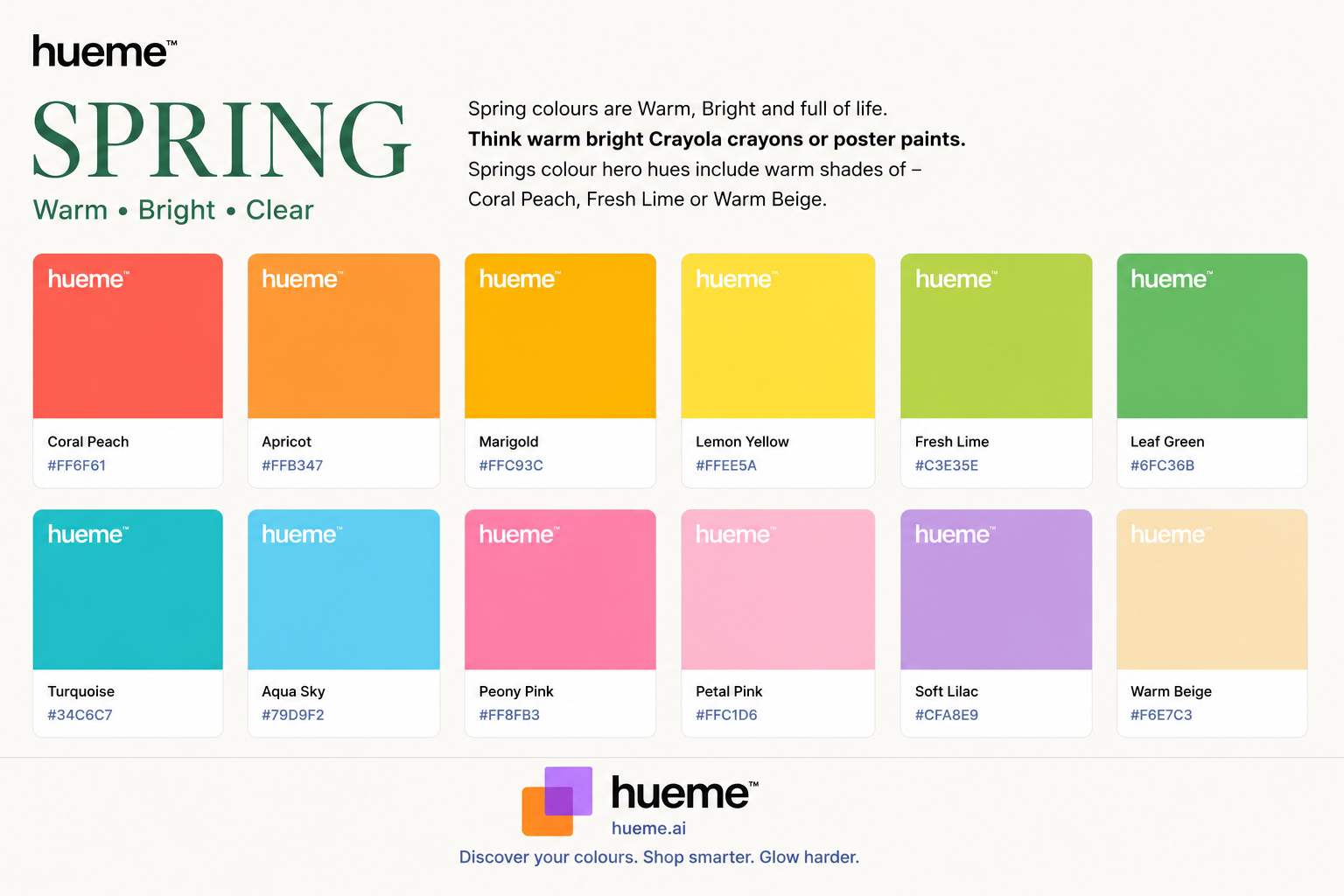
Spring colours are warm, bright and clear. Think the freshness of a garden in full bloom: coral, warm turquoise, soft peach, clear yellow and vivid green. There's a liveliness to them that feels energetic rather than heavy. People with Spring colouring often find that black feels surprisingly harsh next to their face, while their best colours have an almost citrus-like vitality to them. One of the shades Springs frequently discover in their Hueme Fan is Tulip Coral, a warm, vivid pink-red that photographs beautifully against this kind of complexion.
You may be a Spring if...
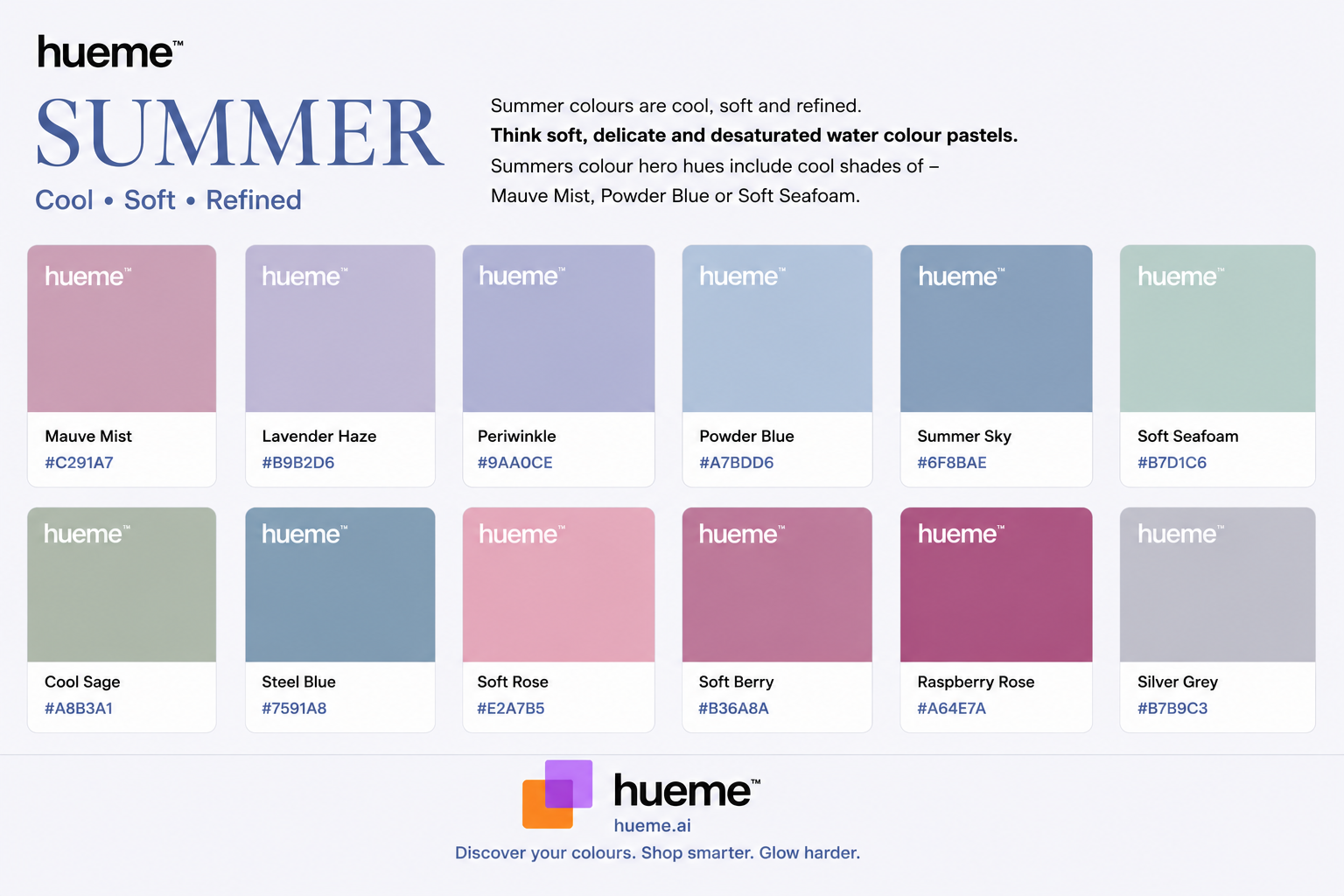
Summer colours are cool, soft and muted. Dusty rose, powder blue, lavender, soft sage, faded mauve. They have a quietness that many people describe as graceful or effortless rather than bold. Summers often find that very saturated, bright colours feel a little jarring and that their complexion looks most at ease in slightly greyed-down shades. English Rose, a cool blush from the Light Summer range, is one of those colours that Summers often describe as simply feeling right the moment they try it.
You may be a Summer if...
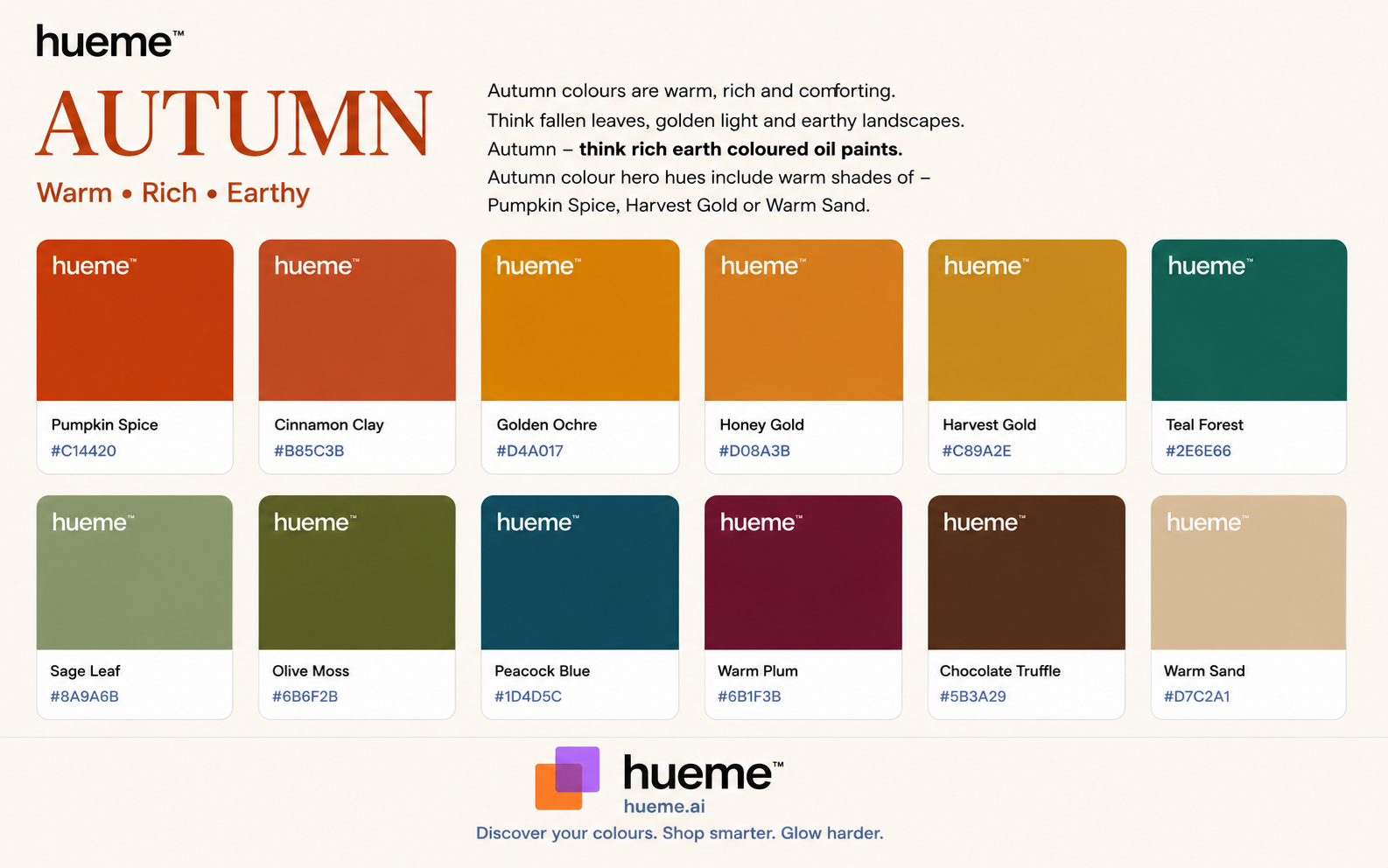
Autumn colours are warm, rich and grounded. Olive, rust, burnt sienna, tobacco, warm teal, cinnamon, moss. They carry the depth and earthiness of the season itself: leather, wood, fallen leaves, afternoon light in October. Autumns tend to look genuinely wonderful in colours that many other people would consider too dark or heavy. Cinnamon Glow, one of the richer mid-range shades, is a good example of the kind of depth that suits this palette without overwhelming it.
You may be a Autumn if...
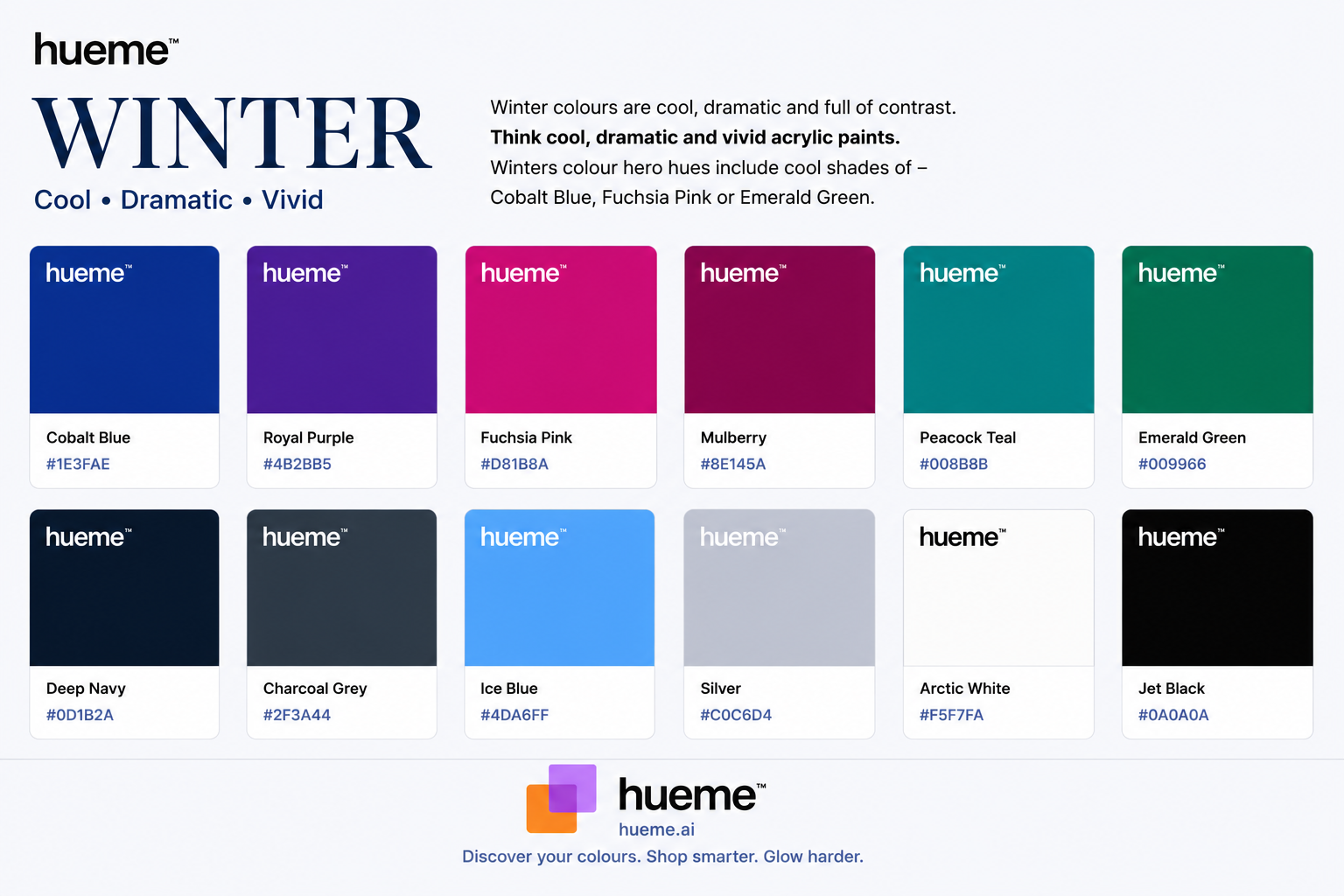
Winter colours are cool, bold and clear. Sapphire, fuchsia, emerald, icy lavender, true black, pure white. They're jewel-like and precise, with very little warmth or softness in them. Winters are often the people who look spectacular in black while everyone around them is telling them they should wear more colour. They also tend to suit the kinds of vivid, saturated shades that would overwhelm a Summer's more delicate complexion. Electric Fuchsia, a high-intensity pink from the Bright Winter palette, is one of those colours that reads as genuinely striking rather than garish when placed against the right skin.
You may be a Winter if...
So why are there twelve seasons?
Not every Autumn looks the same. Some are softer and lighter. Some are darker and more intense. Some sit closer to the Summer border, with a slightly cooler, more muted quality. And some have a depth that approaches Winter territory.
This is why colour analysis divides each of the four main seasons into three sub-seasons, giving twelve in total. A useful way to think about it: the four seasons are the neighbourhoods. The twelve seasons are the individual streets.
Spring
- → Light Spring
- → True Spring
- → Bright Spring
Summer
- → Light Summer
- → True Summer
- → Soft Summer
Autumn
- → Soft Autumn
- → True Autumn
- → Deep Autumn
Winter
- → Bright Winter
- → True Winter
- → Deep Winter
The reason this matters is precision. A Soft Autumn and a Deep Autumn are both warm, both muted and both earthy, but the depth of colour that suits one can feel too heavy or too pale on the other. The twelve-season system makes the colour guidance genuinely useful rather than approximate.
Why the right colours feel different
This is the moment most people have at least a glimpse of when they put on something that genuinely suits them. Not glamorous, necessarily. Just effortless. Like you look like yourself.
When a colour is working with your colouring, a few things tend to happen at once. Skin looks clearer. Fine lines seem less obvious. Eyes appear brighter. If you have any redness, shadows under the eyes or uneven tone, the right colour draws attention away from it without any extra effort.
The right colours don't necessarily make you look more glamorous. They make you look more like yourself.
You often find you need less makeup. The outfit does more of the work. And getting dressed stops feeling like a sequence of small gambles and starts feeling like something you've got a reasonable handle on.
The wrong colours do the opposite. They compete with your natural colouring rather than complementing it. That slight flatness, that sense that something's a bit off, that's usually what's happening. It's not the cut, and it's rarely the fit. It's the colour.
Curious which season you might be?
Maybe you've worn navy for most of your adult life and never quite known why. Maybe you've always been drawn to certain shades in shops but couldn't articulate what they had in common. Maybe you've had a professional colour analysis done years ago and you're wondering whether it still applies.
For most people, understanding their season takes one significant shopping habit away: the one where you buy something because you love it in isolation, without any sense of whether it's actually going to work on you. That habit is expensive, and it's remarkably common.
Hueme Swatch lets you explore all twelve seasonal palettes and see where the colours you already own sit within the system. It's a practical starting point, especially if you're curious but not quite ready to commit to a full analysis.